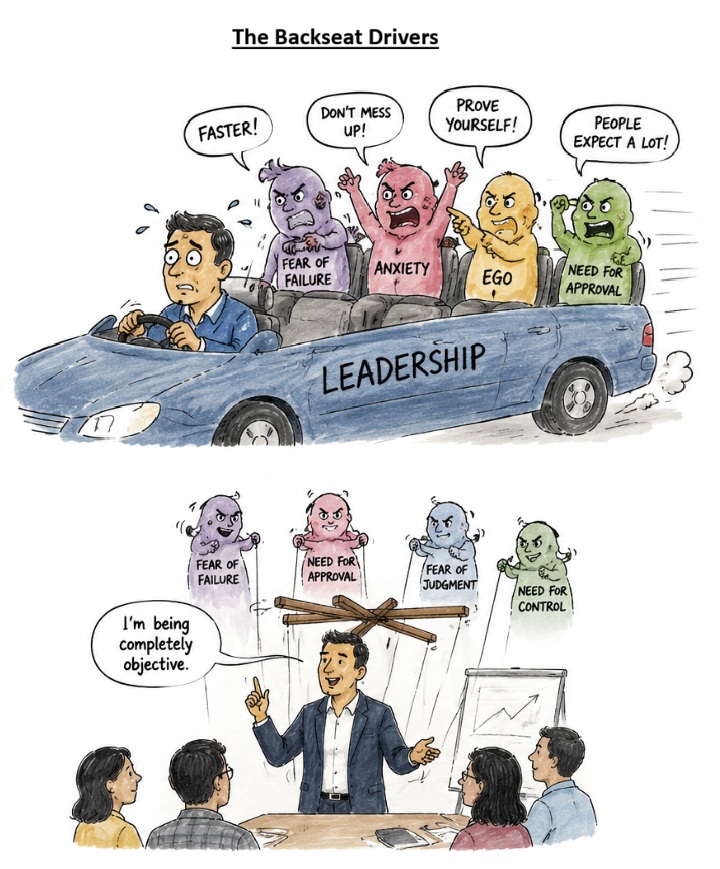
A manager reacts sharply in a meeting.
The room goes silent for a moment.
The conversation moves on.
But something changes afterward.
One team member stops sharing openly.
Another becomes more cautious.
The manager later regrets the reaction and thinks:
"I shouldn't have responded that way."
The reaction lasted only a few seconds.
But the process behind it may have been building silently for years.
Most Leadership Problems Are Not Skill Problems
They are awareness problems.
We often focus on:
- Communication skills
- Decision making
- Execution
- Influence
But we rarely talk about the invisible forces operating underneath our behavior.
Because what we see is often not the real driver.
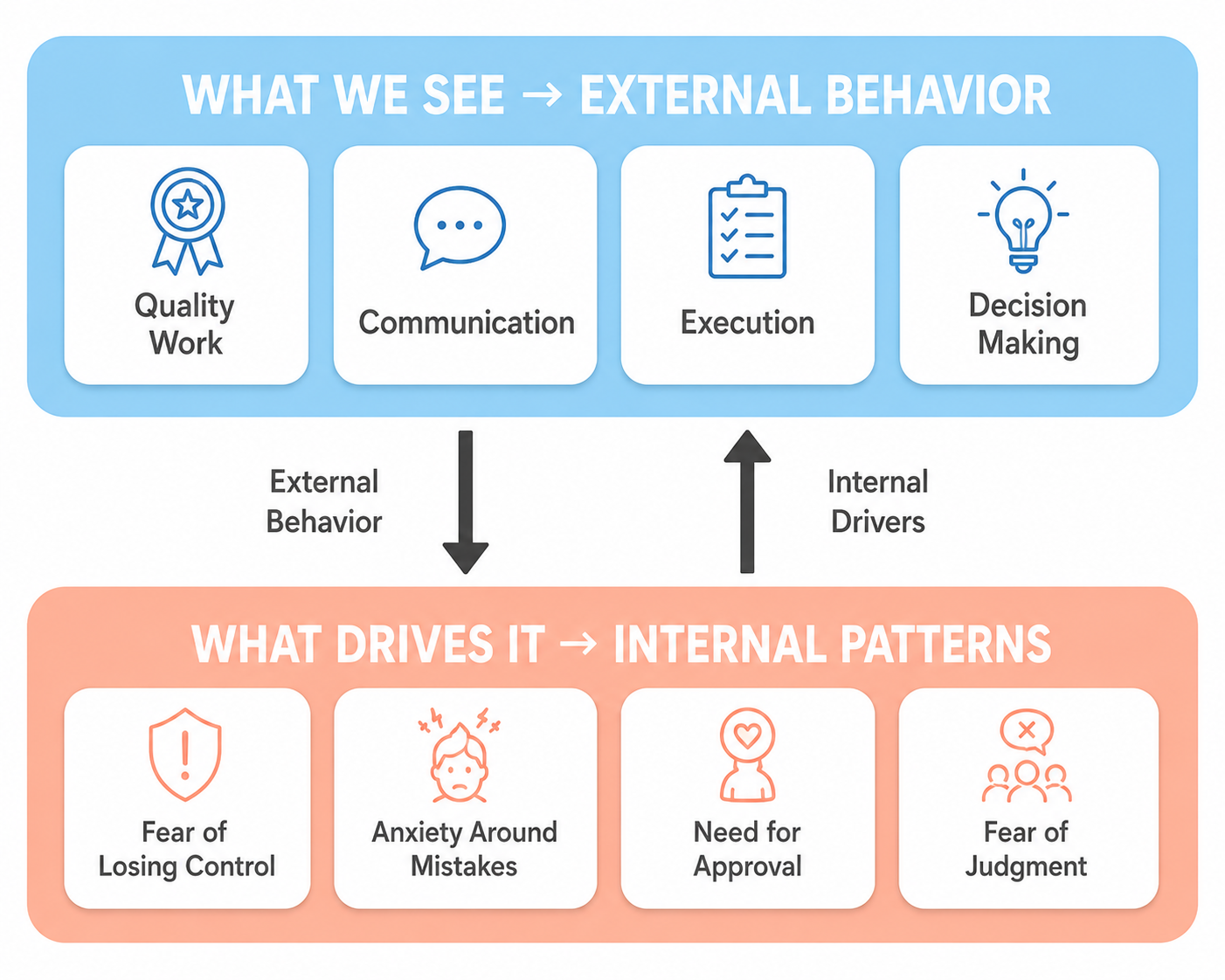
Workplace behavior is often the visible part of a much deeper psychological process.
| What We See | What May Be Driving It |
|---|---|
| Micromanagement | Fear of losing control |
| Defensiveness | Fear of appearing incompetent |
| Employee silence | Fear of judgment |
| Over-checking | Anxiety around mistakes |
| Perfectionism | Discomfort with uncertainty |
Many workplace reactions are not fully intentional.
They are patterned.
Built through experiences, beliefs, fears, and habits accumulated over years.
What We See vs What Actually Drives It
Example 1 — Micromanagement
Conscious level:
“I just want quality work.”
Subconscious level:
“If things go wrong, I may lose control or respect.”
What appears as high standards can slowly become micromanagement, over-checking, and difficulty delegating.
Example 2 — Defensive Manager
Conscious level:
"I'm correcting the team."
Unconscious level:
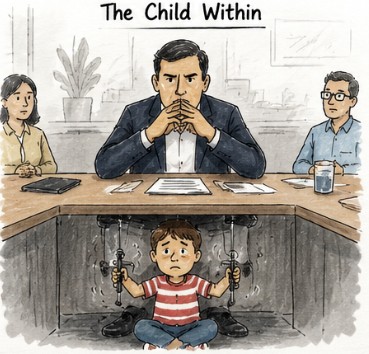
"I can't afford to look incompetent."
Sometimes what appears as correction is actually self-protection.
Example 3 — Employee Silence
Conscious level:
"I have nothing to add."
Subconscious level:
"What if my idea sounds foolish?"
or
"It's safer to stay quiet than be judged."
What appears as disengagement may actually be fear.
The Mind Beneath the Behavior

Most workplace behavior follows automatic patterns built over years.
A large part of it comes from something much less visible.
Some patterns run automatically in the background.
Some reactions emerge from emotional layers we barely recognize in ourselves.
These invisible processes quietly influence how people:
- Lead teams
- Respond to feedback
- Handle pressure
- React during conflict
- Make decisions
Often without realizing it.
Sometimes the most important leadership skill is noticing what is happening inside us before responding to what is happening around us.
The Invisible Side of Workplace Stress
Most people assume workplace stress comes only from:
- Deadlines
- Workload
- Pressure
But often people are managing something else beneath the surface.
- The need for approval
- Fear of failure
- Avoidance of conflict
- Fear of appearing incompetent
These patterns quietly consume mental energy.
Sometimes people are not only managing work.
They are managing what work psychologically activates within them.
Why Self-Awareness Matters in Leadership
Leadership is often discussed in terms of:
- Communication
- Execution
- Influence
- Decision-making
But there is another dimension that receives far less attention:
The ability to observe one’s own mind while leading others.
Because reactions spread quickly through teams.
- An anxious leader can create anxious meetings.
- A defensive manager can create silent teams.
- A calm and self-aware leader can create psychological safety.
Self-awareness may not solve every workplace problem.
But without it, the same patterns quietly repeat through teams, meetings, and decisions.
Whether consciously or unconsciously, people often lead from their inner state.
So How Do We Begin Understanding the Mind?
Not by controlling every thought.
And not by overanalyzing ourselves.
Understanding the mind begins with observation.
Small moments reveal a great deal:
- Irritation during disagreement
- Defensiveness after feedback
- Emotional reactions during uncertainty
- Repeated behavioral patterns
- The tone behind our responses
Instead of immediately reacting, it helps to pause and ask:
- Why did this affect me so strongly?
- What exactly was triggered here?
- Is this reaction only about the present moment?
Pause creates awareness.
And awareness changes behavior more than advice often does.
5 Daily Practices to Build Self-Awareness
Understanding your mind isn’t about perfect control.
It’s about noticing patterns so you can choose differently.
1. The 3-Second Pause
Before responding to criticism or conflict, count to three and ask:
“What emotion is driving this reaction?”
This tiny gap breaks automatic patterns and creates space for conscious choice. [Harvard Health, 2026]
2. Feedback Journal
After difficult conversations, spend two minutes writing:
- What triggered me?
- What past experience might this connect to?
- How could I respond differently next time?
3. Pattern Tracking
Notice repeated reactions.
Track them for one week and identify recurring triggers.
4. Pre-Meeting Check-In
Before joining a meeting, ask:
“What state am I bringing into this room?”
“Am I anxious, defensive, or calm—and how will that affect others?”
5. After-Action Reflection
End your day with one question:
"Where did I react automatically today? Where did I choose consciously?"
Self-awareness is not a destination.
It is a daily practice.
These small moments of observation compound over time.
You may not become a perfect leader.
But you can become a more conscious one.
A Final Reflection
The quality of leadership depends on how deeply a person understands their own mind.
Understanding the mind does not make anyone a perfect leader.
But it can make leadership more conscious.
The tone of our reactions, the patterns in our behavior, and the emotions behind our decisions often reveal more than we realize.
And perhaps better leadership begins not only by managing people well, but by observing ourselves honestly.
Before managing people, most of us need to understand the mind managing us.
What workplace behavior have you observed that seemed to have a deeper psychological driver beneath it?
If this topic resonated with you, you may also enjoy
- Understanding Your Inner Child, Parent and Adult
- Maximizing Impact: The Balance Between Maximizers and Satisficers
- How Emotions Influence Creativity and Motivation
Research and References
These foundational studies support the psychology behind workplace behavior patterns discussed above.
- Daniel Kahneman & Amos Tversky (1974). Judgment under Uncertainty: Heuristics and Biases.
- Amy Edmondson (1999). Psychological Safety and Learning Behavior in Work Teams.
- Positive Psychology (2019). Self-awareness exercises


Leave a Reply