I’ve been noticing something interesting.
AI isn’t just helping us work. It is quietly becoming part of how we think.
We ask it to generate ideas, summarize reports, explain concepts, draft messages, and solve problems.
None of this feels unusual anymore.
But this does.
For most of history, intelligence was something people developed.
Today, it is increasingly something we can access.
What happens to the human mind when intelligence becomes available on demand?
The Temptation to Stop Thinking
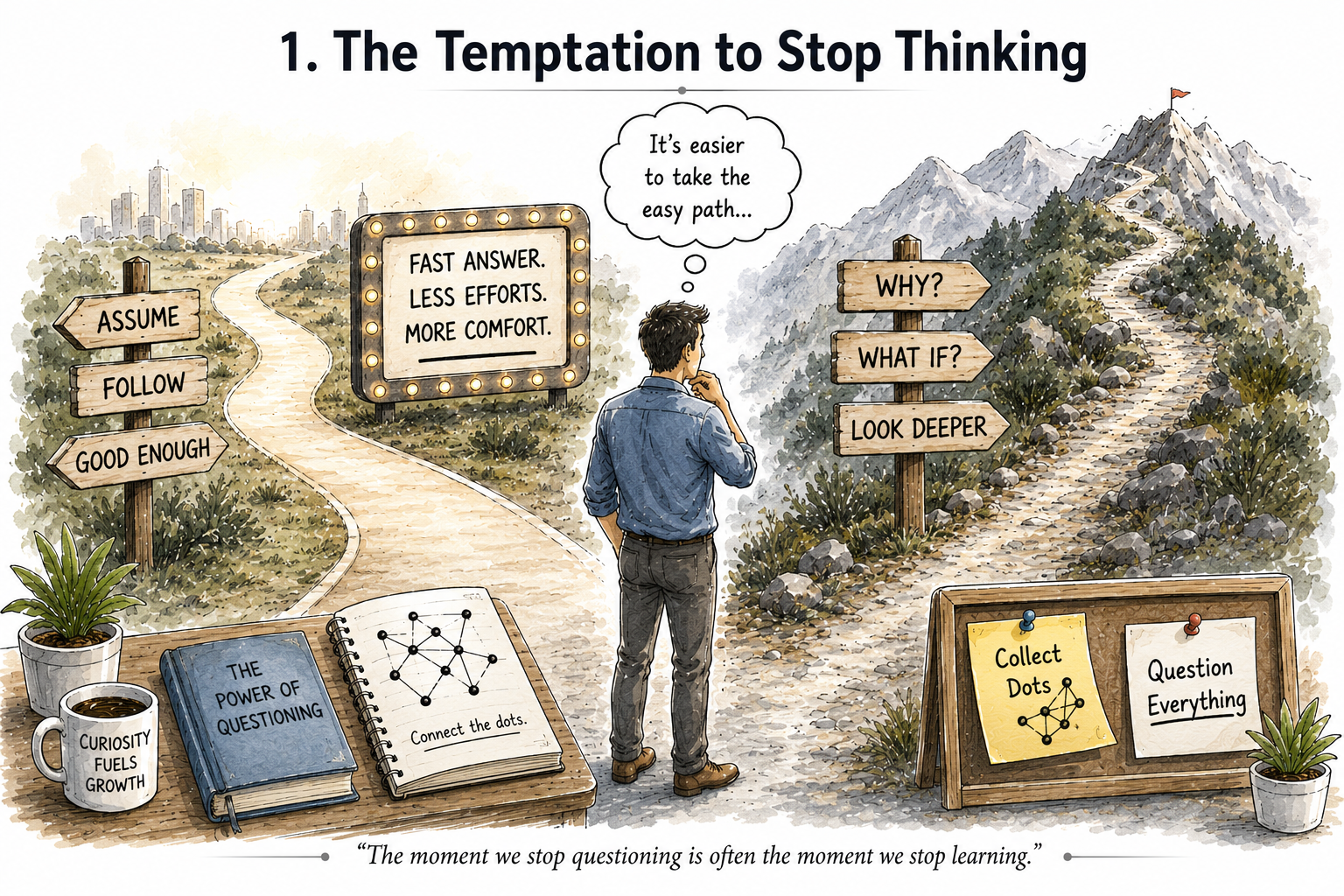
When AI gives a good answer, it’s tempting to stop there.
Not because we’re lazy.
Because the answer often feels good enough.
A question appears. An answer arrives within seconds.
And the thinking process that might have followed sometimes ends before it really begins.
The urge to explore further or consider alternative perspectives can quietly fade away.
Psychologists have observed a similar pattern for years. When tools reduce mental effort, humans naturally rely on them. (Risko & Gilbert, 2016)
Most of us no longer remember phone numbers. We remember where to find them.
A few years ago, we searched for answers. Today, we sometimes ask AI the question before we’ve fully finished thinking about it ourselves.
AI may be extending that pattern into activities that once required more of our own thinking.
And that’s not necessarily a problem.
The real question is whether we continue practicing the abilities that AI cannot practice for us.
Answers Are Easy. Judgment Isn’t.
AI can help us find information faster than ever before.
It can explain concepts, generate ideas, summarize research, and offer solutions within seconds.
That’s a remarkable capability.
But information is only one part of thinking.
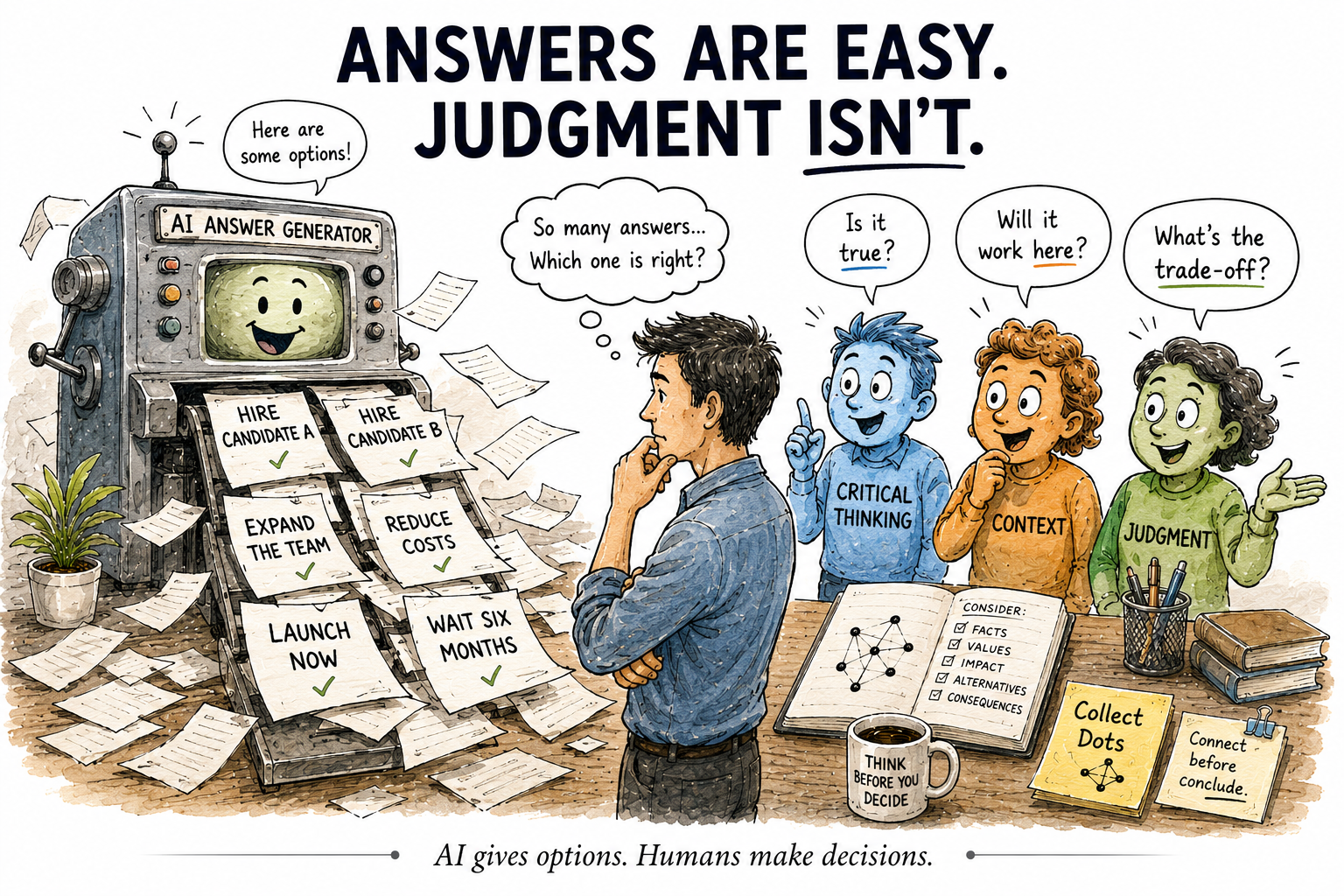
- An answer can be accurate and still be wrong for a particular situation.
- A suggestion can be useful and still miss important context
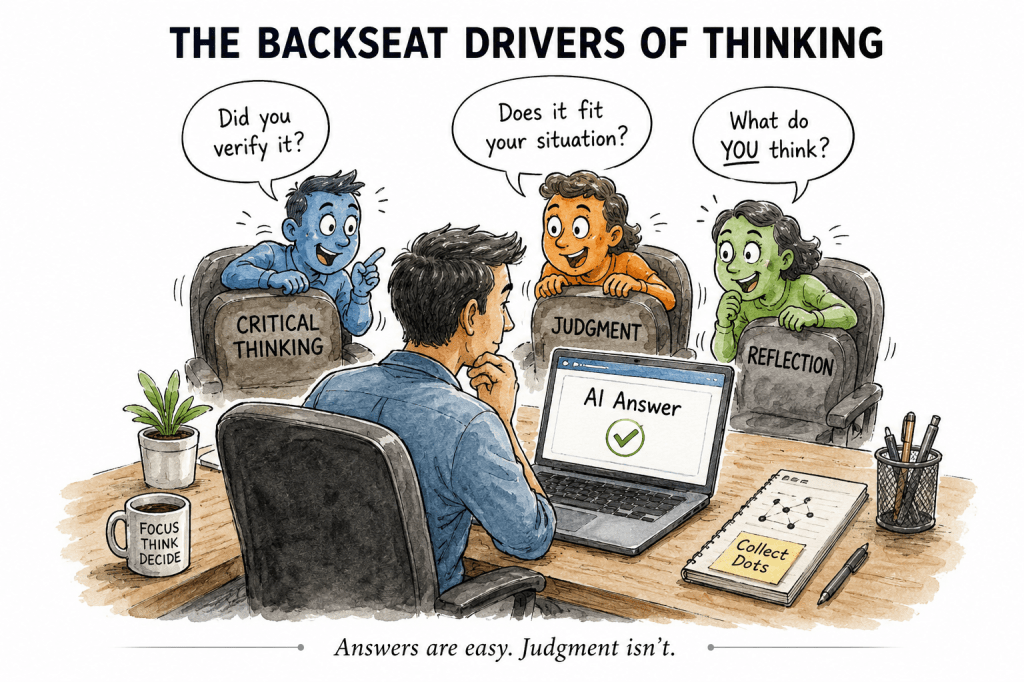
That’s where judgment comes in.
Reflection asks a different question:
“What do I actually think about this?“
These abilities have always developed through practice, experience, and sometimes even struggle.
Research in learning science suggests that some of our strongest learning happens when we actively work through problems rather than simply receiving answers. (Bjork & Bjork, 2011)
AI can generate information. It cannot develop judgment for us.
And the more capable AI becomes, the more valuable that distinction may become.
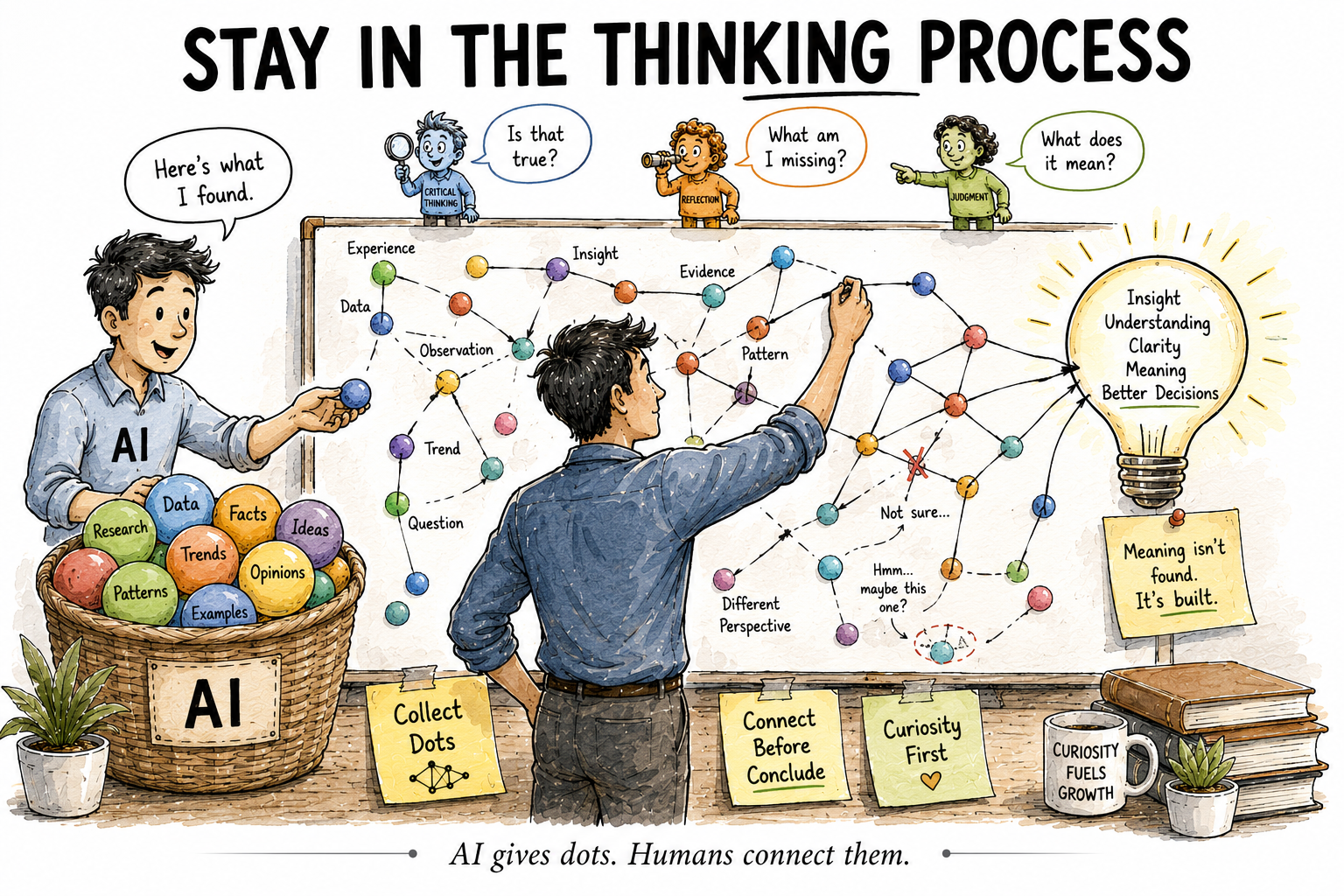
Stay in the Thinking Process
AI works best when it expands our thinking rather than replaces it.
One simple practice is to pause before accepting an answer.
Ask yourself:
- Do I agree with this?
- What might be missing?
- What is my own view?
The goal isn’t to reject AI. The goal is to remain an active participant in the thinking process.
AI can generate answers.
We still need to develop judgment.
For many people, AI isn’t replacing thinking. It’s helping them think faster, learn faster, and explore ideas they might never have considered on their own.
A Final Reflection
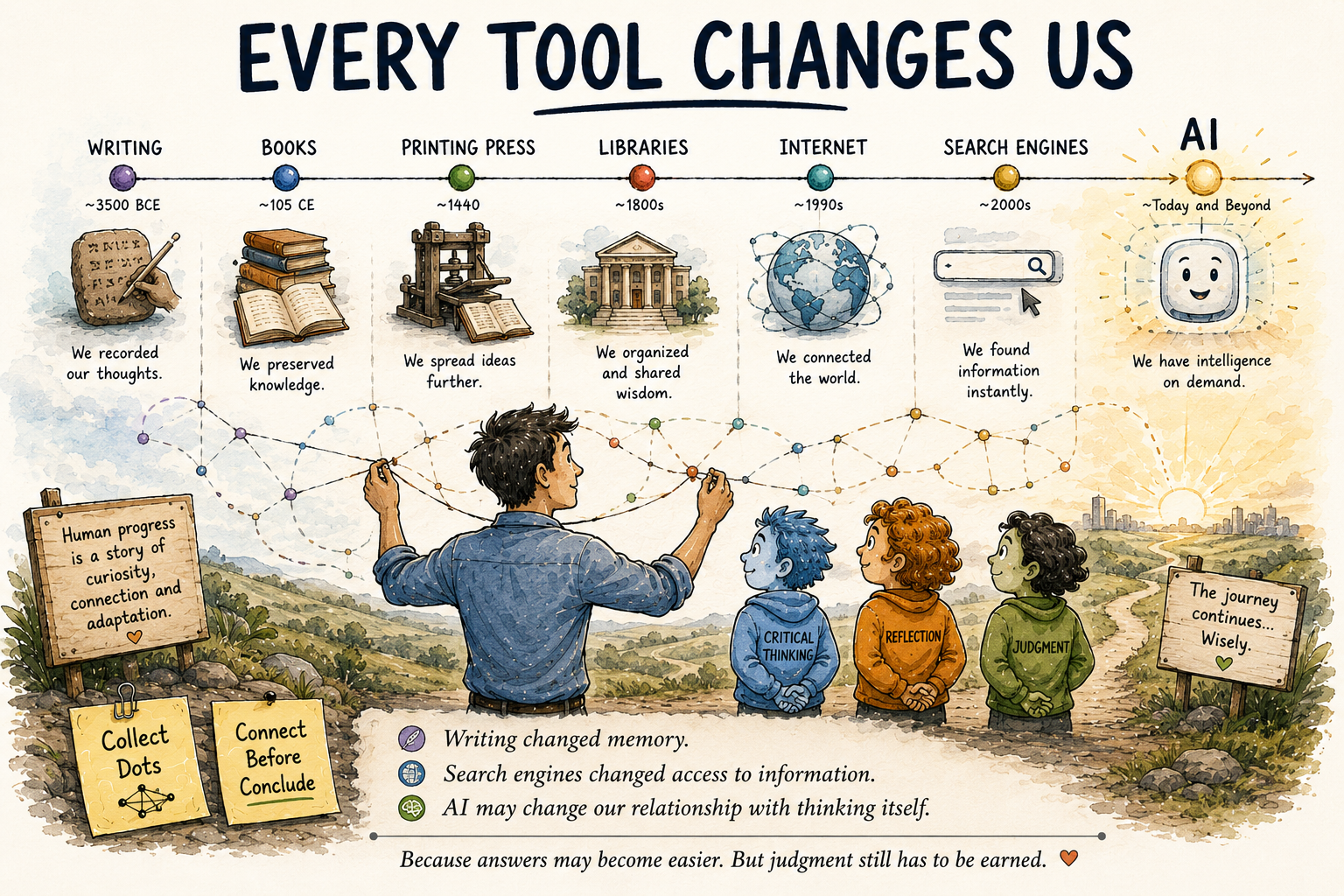
Every major technology changes something about us.
Writing changed how we remember.
Search engines changed how we find information.
AI may change something even more personal: our relationship with thinking itself.
The challenge isn’t whether AI becomes smarter.
The challenge is whether we continue developing the abilities that have always required human effort: critical thinking, judgment, reflection, and wisdom.
Perhaps the goal isn’t to think less because AI exists.
Perhaps it’s to think differently and more consciously.
Because answers may become easier.
But judgment still has to be earned.
The Dots Behind This Reflection
This article is a reflection on how AI may influence the way we think, learn, and make decisions. It draws on research from cognitive psychology, learning science, and decision-making.
Research and Further Reading
Risko, E. F., & Gilbert, S. J. (2016). Cognitive Offloading
Bjork, R. A., & Bjork, E. L. (2011). Desirable Difficulties


Leave a Reply