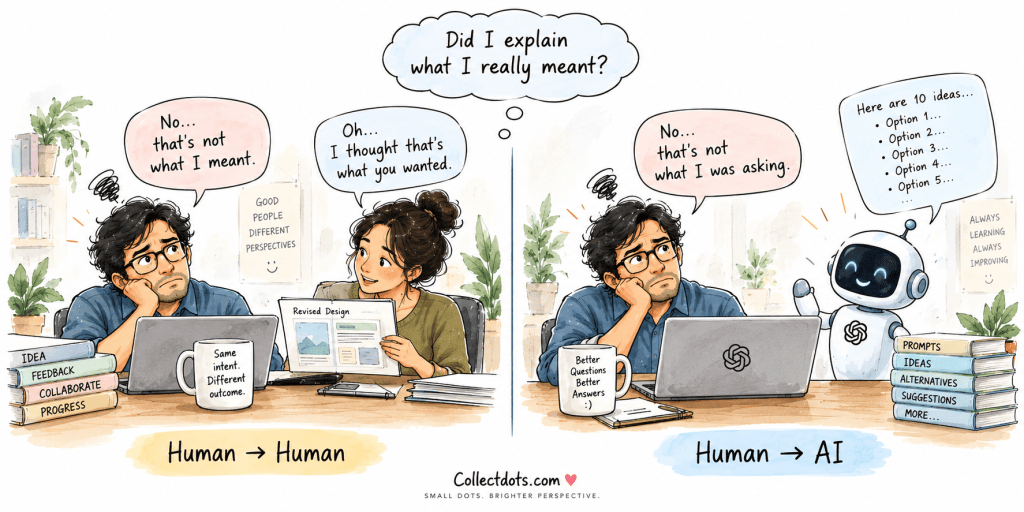
“I didn’t mean it that way.”
“That’s not what I was asking.”
“You misunderstood me.”
We’ve all said these words.
To a colleague. A friend. A partner. And now, increasingly, to AI.
We type a few words. AI responds instantly. Sometimes brilliantly. Sometimes with a long answer to a question we didn’t quite mean to ask.
Maybe the problem isn’t communication. Maybe we’re communicating too quickly.
In a world of instant answers, perhaps good communication needs something we often forget to give it: time to listen, understand, and think.
We Don’t Always Communicate What We Mean
You send a message to a colleague:
“Can you make this better?”
They come back with something completely different from what you had in mind.
Your first reaction is often:
“How did they not understand me?”
But perhaps the more useful question is: Did I make myself clear?
We often communicate from our perspective, assuming the other person has the same context, priorities, and understanding.
Good communication isn’t just saying what we think. It’s helping the other person understand what we mean.
Research note: We often assume that what is clear in our own mind will be clear to someone else. Research by Keysar and colleagues found that people can rely too heavily on their own perspective when interpreting communication, sometimes overlooking information that is not shared with the other person. Other research found that speakers tend to overestimate how clearly their intended meaning has been understood.
In other words, the gap between what we mean and what others understand can be bigger than we realise.
Read the research: Speakers’ Overestimation of Their Effectiveness
“Before asking, explaining, or responding, pause and ask: “What does the other person need to know to understand what I mean?”
AI Will Answer Even When We’re Not Clear
You ask AI:
“Give me some ideas to improve this.”
Seconds later, you have 20 ideas.
And then you realise: you weren’t even sure what you wanted to improve.
What Happens to the Human Mind When Intelligence Is Available on Demand?
AI doesn’t usually ask us to slow down and clarify. It can answer an incomplete question and still produce something that looks useful.
More answers don’t always mean more clarity.
Research note: Research on information overload suggests that more information and choices do not necessarily make decisions easier. Read the research
“AI can help us explore possibilities. We still have to decide what matters.”
Two Listeners, Two Ways of Communicating
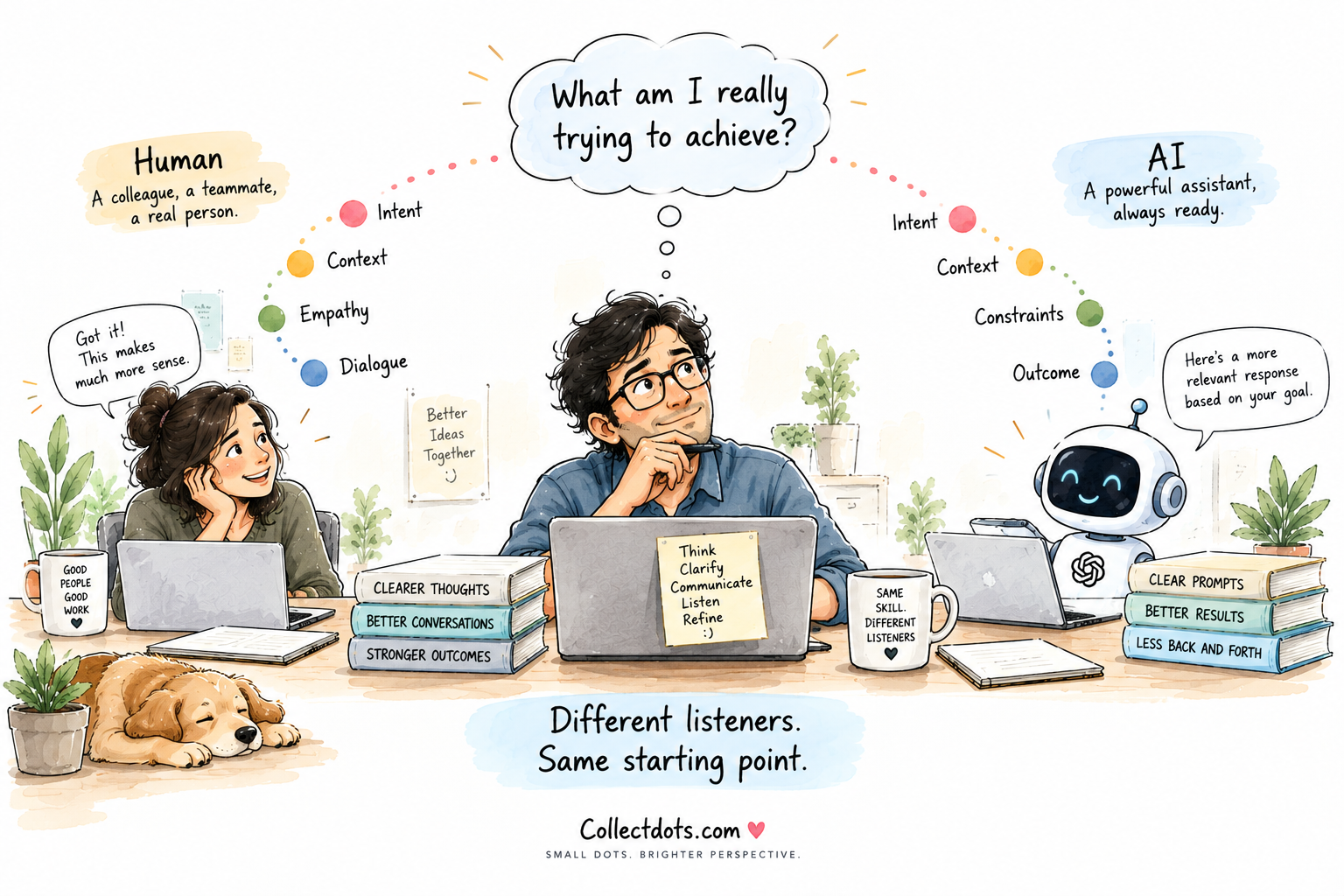
We communicate with people. We interact with AI.
But both require something fundamental: making our intent clear.
With people, communication depends on more than words. Context, emotion, tone, and perspective all shape what is understood.
With AI, the ingredients are different. We need to communicate our intent, context, constraints, and expected outcome.
Research note: Research shows that effective communication requires us to consider what the other person knows and can see from their perspective. We can otherwise rely too heavily on our own viewpoint when interpreting meaning. Read the research: Taking Perspective in Conversation
“The skill isn’t simply learning to prompt AI. It’s learning to express what we actually mean.”
The Skill Behind Both
Whether we are talking to a person or AI, the real challenge is often the same:
Do I know what I am trying to communicate?
A simple pause can help:
Pause → Clarify → Communicate → Listen → Refine
With people, add empathy.
With AI, add context and constraints.
Research note: Communication research suggests that successful communication is not just about transmitting information. It depends on whether the intended meaning is actually understood by the receiver. Read the research
Good communication isn’t about saying more. It’s about creating shared understanding.
“Before you communicate, clarify your thoughts first.”
Final Reflection: Maybe We Need to Slow Down
We used to think communication was about finding the right words.
But perhaps the first step is finding the right thought.
With people, that means taking time to listen, understand, and consider another perspective.
With AI, it means being clear about what we want before asking for an answer.
Because communication may be getting faster. But understanding still takes time.
Collect Dots Reflection:
“Before we improve how we communicate, perhaps we need to slow down enough to understand what we mean.”


Leave a Reply