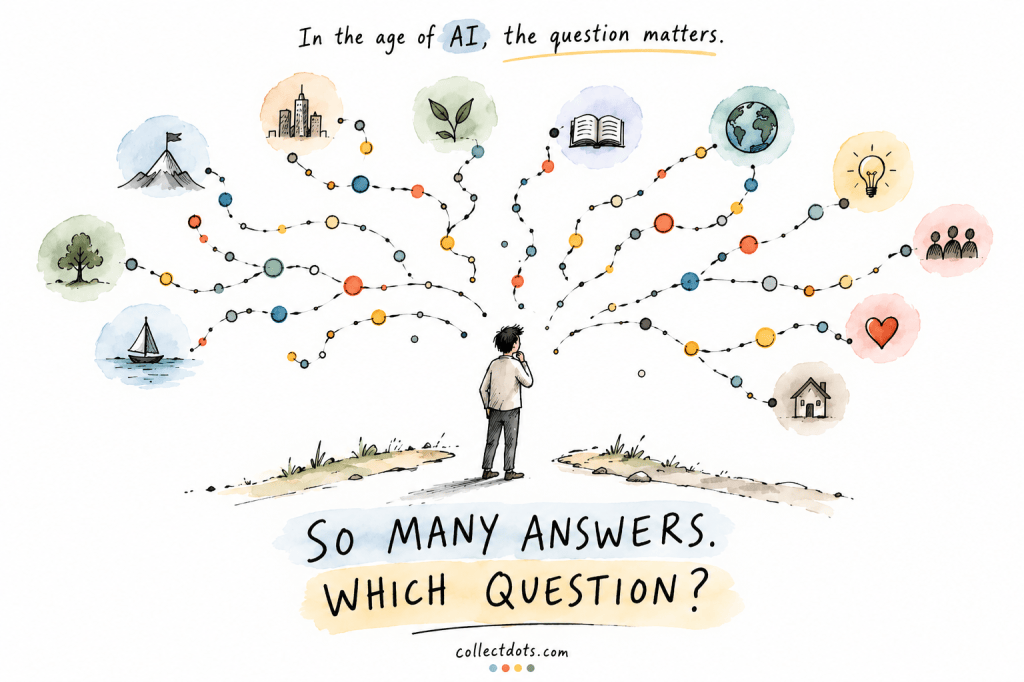
“What should I do?”
It is one of the easiest questions to ask AI.
But perhaps a better question comes first:
“What am I actually trying to figure out?”
Because AI can give us a brilliant answer to the wrong question.
I started thinking about this while reading Warren Berger’s The Book of Beautiful Questions.
The book made me look at AI a little differently.
“When AI can answer so much, what is worth asking?”
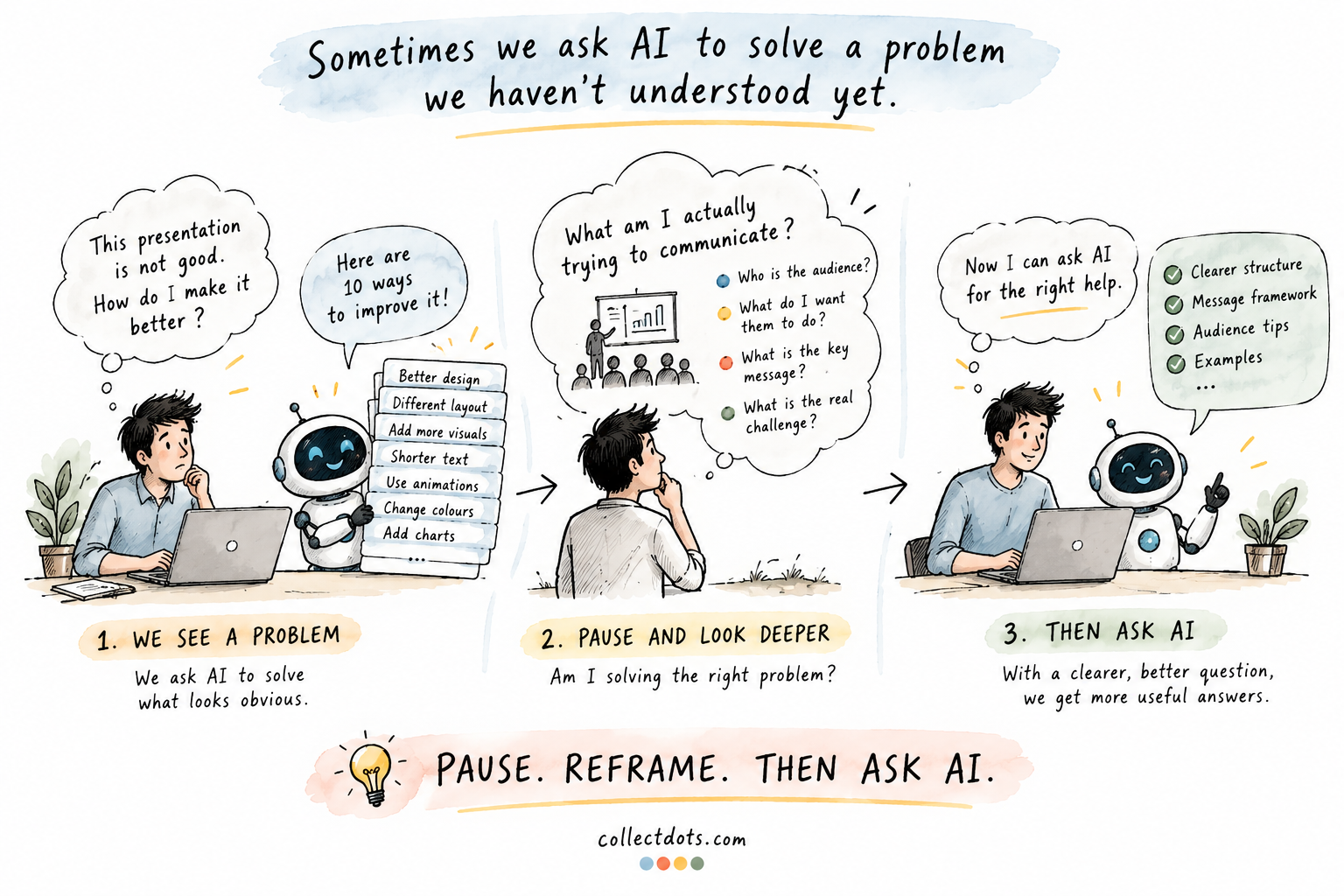
Sometimes We Ask AI to Solve a Problem We Haven’t Understood Yet
We have become very comfortable asking AI for answers.
“Which option should I choose?”
“Give me some ideas.”
“How can I fix this?”
And AI responds almost instantly.
But sometimes there is a small problem hiding inside the question.
We have already decided what the problem is.
If I ask AI, “How can I make this presentation better?”, I have assumed the presentation is the problem.
Maybe it isn’t.
Maybe the story is unclear.
Maybe the audience is wrong.
Maybe I am trying to communicate something that isn’t clear even to me.
AI can help me solve the problem I give it.
But it may not know that I started with the wrong problem.
This is something I started noticing while reading Warren Berger’s The Book of Beautiful Questions. The book kept nudging me one step backwards, from “What is the answer?” to “What am I assuming?”
Harnessing Confirmation Bias for Better Decision-Making
And that small step backwards may be more important than it sounds in the age of AI.
Research note
Research on problem framing shows that how we define a problem can influence the choices we make, meaning the way we frame a question can shape the answers we consider. Tversky and Kahneman’s classic work demonstrated this framing effect in decision-making.
Read the research: The Framing of Decisions and the Psychology of Choice by Tversky & Kahneman.
The Question Behind the Question
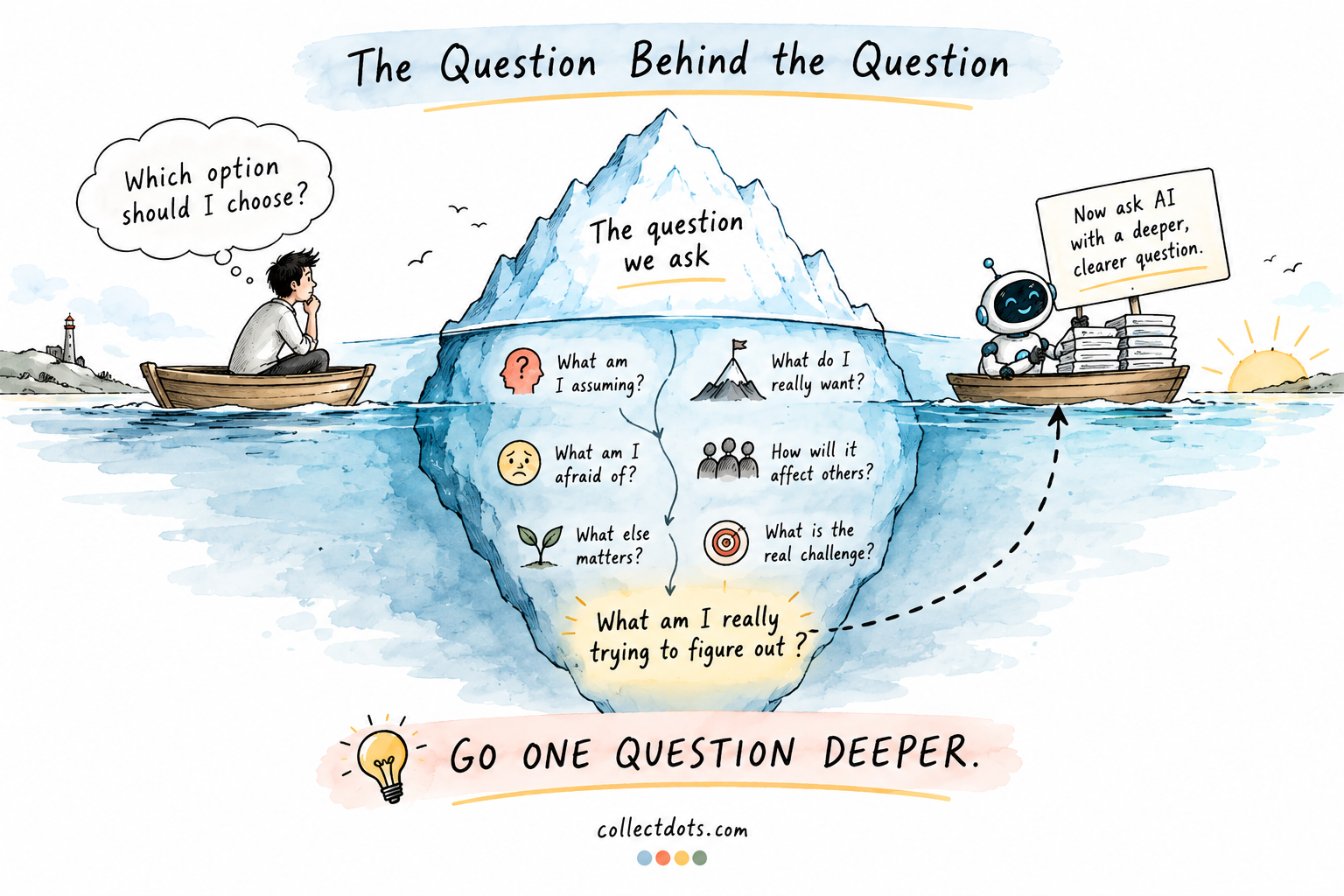
We often ask AI for the decision before asking ourselves what is driving it.
“Which job should I take?”
“Should I start this business?”
“Should I say yes?”
But underneath each question may be another one:
“What am I assuming?”
Maybe I am assuming that more money means a better job.
Maybe I am assuming that saying yes will make someone happy.
Maybe I am assuming there are only two choices.
Berger’s book made me notice how easily we can mistake our first framing of a problem for the problem itself.
And perhaps this is where AI can become more useful. Instead of asking it only for an answer, we can ask:
“What assumptions am I making?”
Now AI is not just answering the question.
It is helping us question the question.
Research note
Research on cognitive reflection suggests that people can sometimes accept an immediately appealing answer without stopping to examine whether it is actually correct, which is one reason pausing to question our first response can improve reasoning.
Read the research: Frederick, S. (2005), Cognitive Reflection and Decision Making. Read the research
“The first answer that comes to mind may be useful. The first question that comes to mind may need questioning.”
A Better Question Can Open More Possibilities
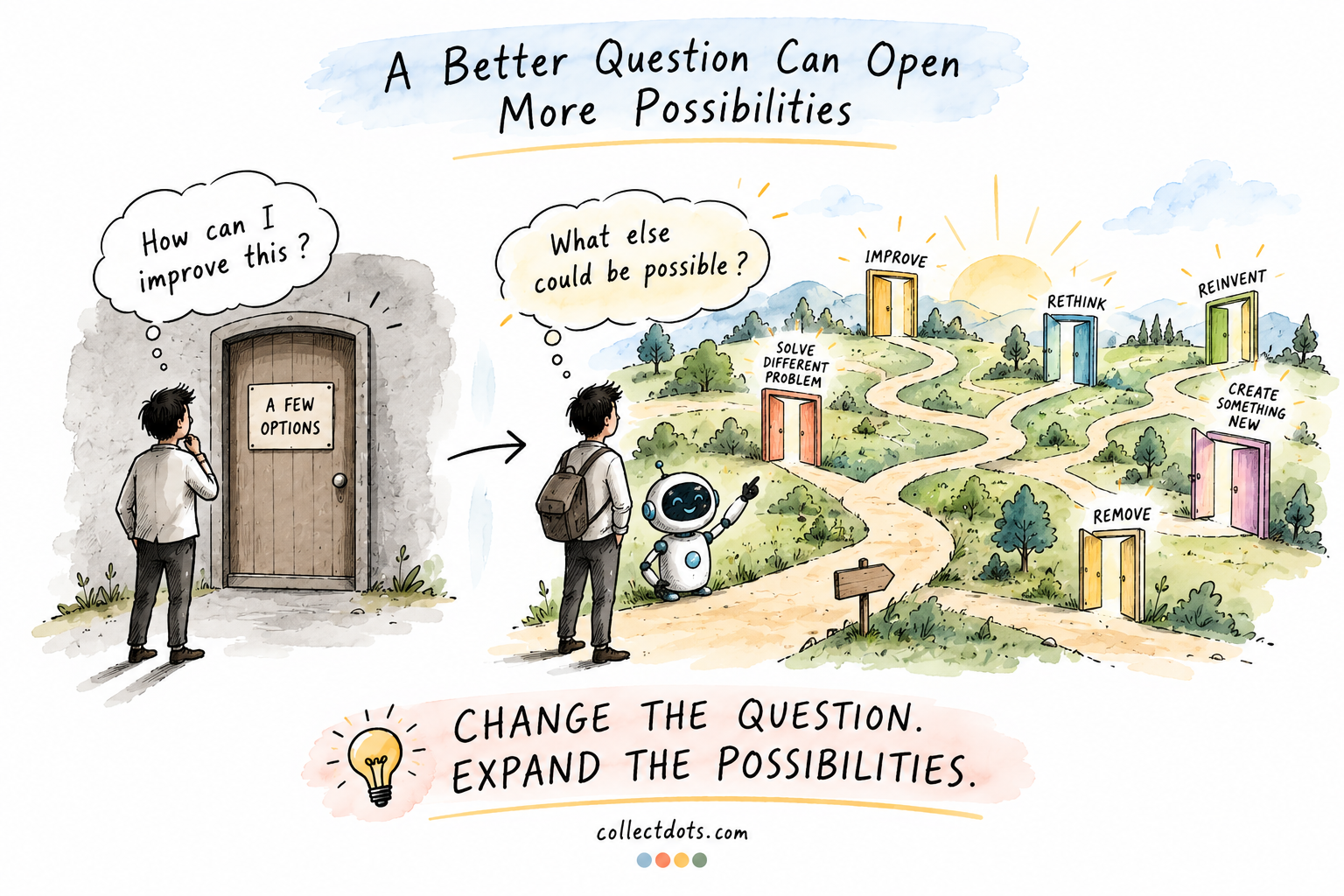
We often ask AI for more ideas.
But sometimes we don’t need more ideas. We need to see the problem differently.
“Give me ideas for a new business.”
“Give me ideas to improve this product.”
“Give me ideas for my next career move.”
AI can produce dozens of answers.
But what if we asked:
“What problem am I not seeing?”
That question changes the direction of the conversation.
This was another idea from Berger’s book that stayed with me. Creativity isn’t always about producing more answers. Sometimes it begins by questioning the problem itself.
And this feels especially relevant with AI.
AI can dramatically expand the number of ideas we can generate.
A better question can expand what we think is possible.
Research note
Research on creative problem-solving suggests that how we construct and define a problem influences the quality and originality of the solutions we eventually generate.
Read the research: Reiter-Palmon et al., Problem Construction and Creativity
“Sometimes creativity begins before the first idea, with a better way of seeing the problem.”
Sometimes the Question Is About Someone Else
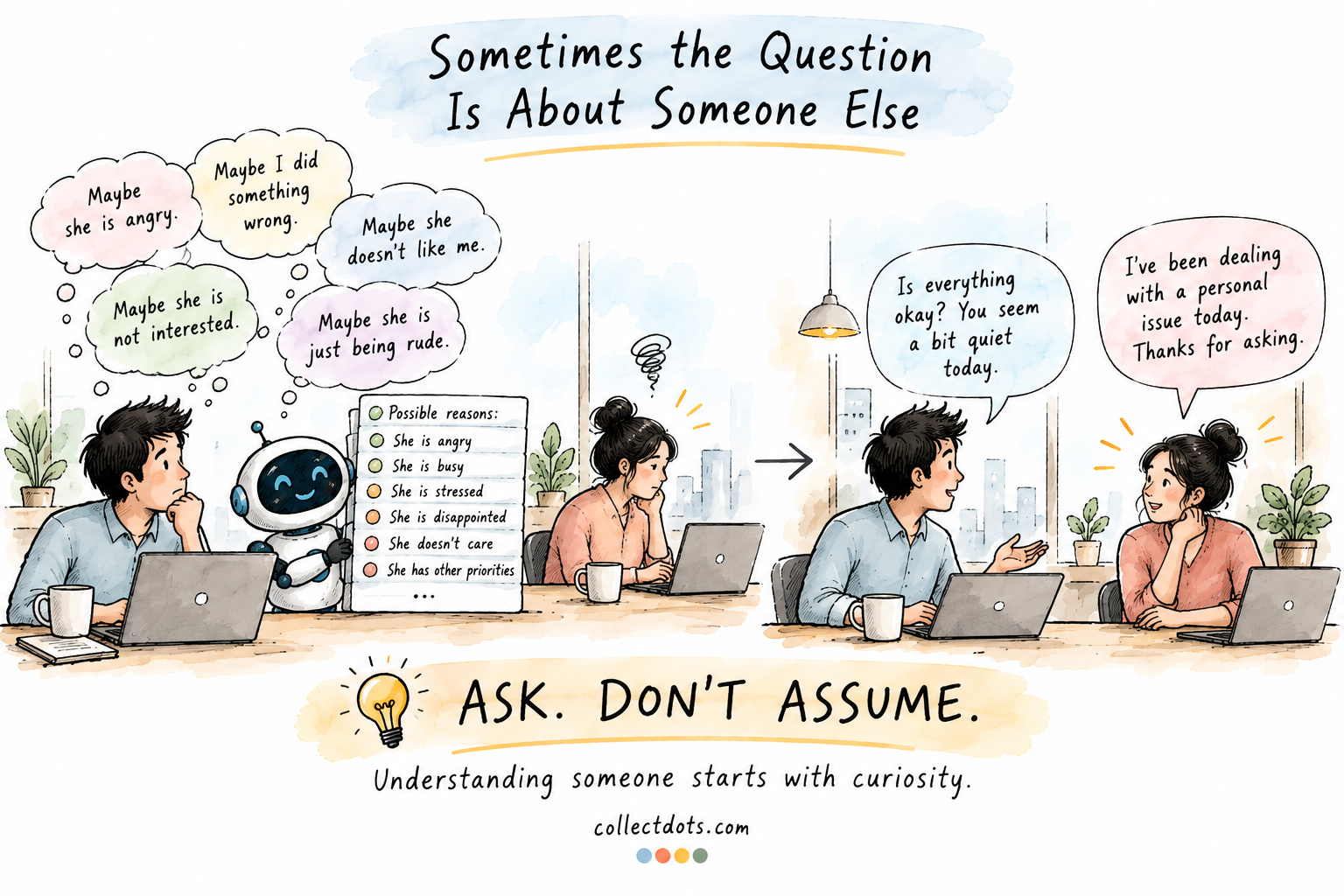
We are quick to explain other people’s behaviour.
“Why is he behaving like this?”
“Why did she react that way?”
We may even ask AI to help us understand.
And it will happily give us several possible explanations.
But there is another question I find more useful:
“What don’t I understand yet?”
Maybe Communication Isn’t the Problem. Maybe We’re Communicating Too Quickly.
That small shift moves us from explaining someone to becoming curious about them.
This was another idea from Berger’s book that stayed with me. Good questions aren’t only about making better decisions or finding better ideas. They can change the way we approach another person.
AI can give us possible perspectives.
But perhaps understanding someone still begins with something much simpler:
being willing to ask before assuming.
Research note
Research suggests that simply imagining another person’s perspective does not always make us more accurate. One study involving 25 experiments found that getting information directly from the other person through conversation was more reliable for understanding them than merely trying to take their perspective.
Read the research: Eyal, Steffel & Epley, “Perspective Mistaking”
”Sometimes curiosity understands what assumption cannot.”
Maybe Leadership Starts With a Better Question
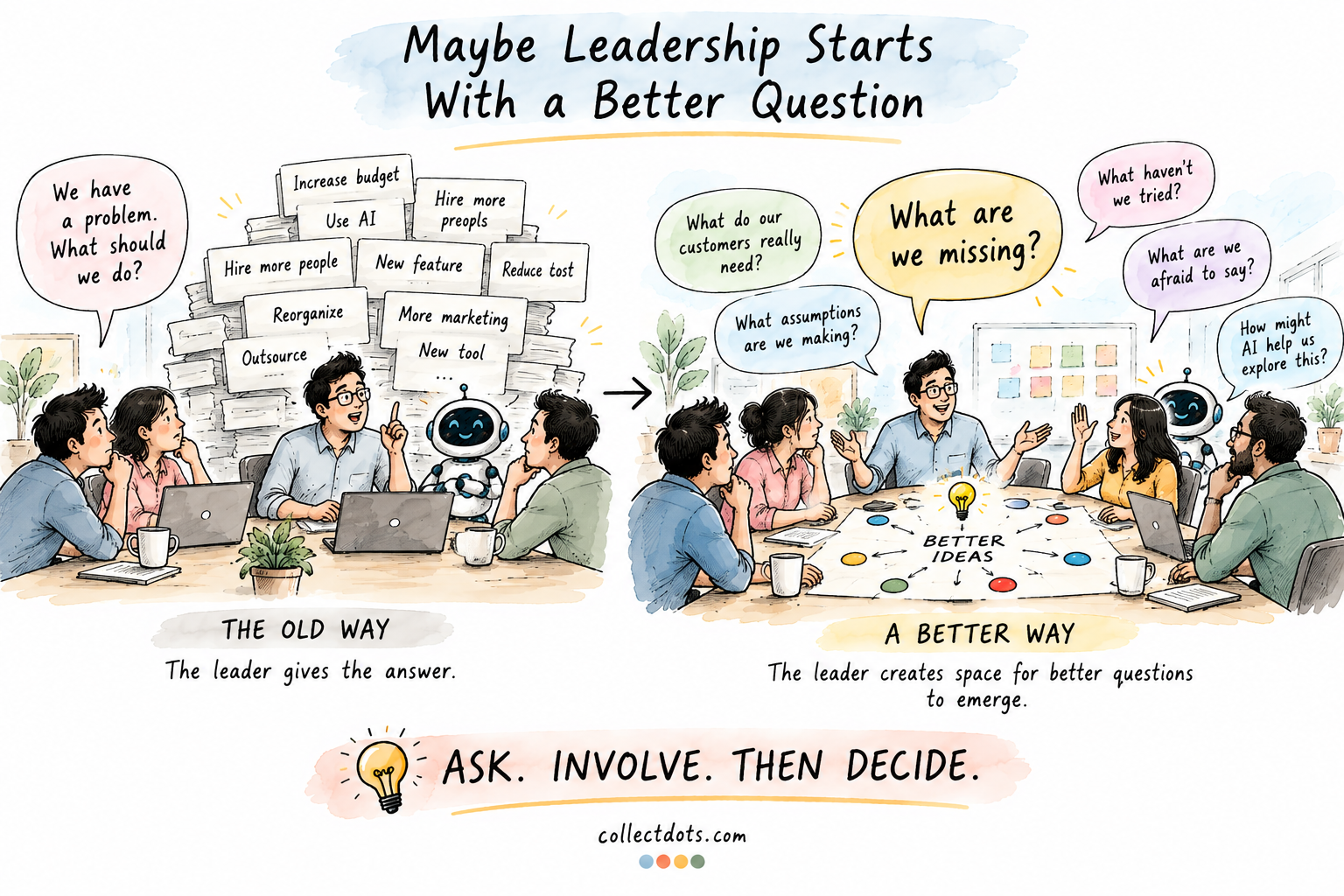
The same thing happens at work.
Someone brings a problem to a leader, and the natural response is:
“Here’s what we should do.”
It’s efficient. It can even be helpful.
But Berger’s book made me wonder about another possibility:
What if a leader’s job is not always to provide the answer, but to help the right question surface?
In an AI-enabled workplace, this may become even more interesting. When everyone can ask AI for an answer, a leader can spend less energy being the person with all the answers and more energy asking:
“What are we missing?”
“What haven’t we questioned?”
The Invisible Psychology That Drives Workplace Behavior – And How to Change It
“What should we be asking?”
Perhaps curiosity isn’t the opposite of leadership.
Perhaps it is part of it.
Research note
Research on psychological safety shows that when people feel safe to speak up, question, and share concerns, teams are more likely to learn from one another and discuss problems openly.
Read the research: Edmondson, A. (1999), Psychological Safety and Learning Behavior in Work Teams. Read the research
“A leader doesn’t always need to have the answer. Sometimes they need to make it safe for someone else to ask the question.”
So, What Is Worth Asking?
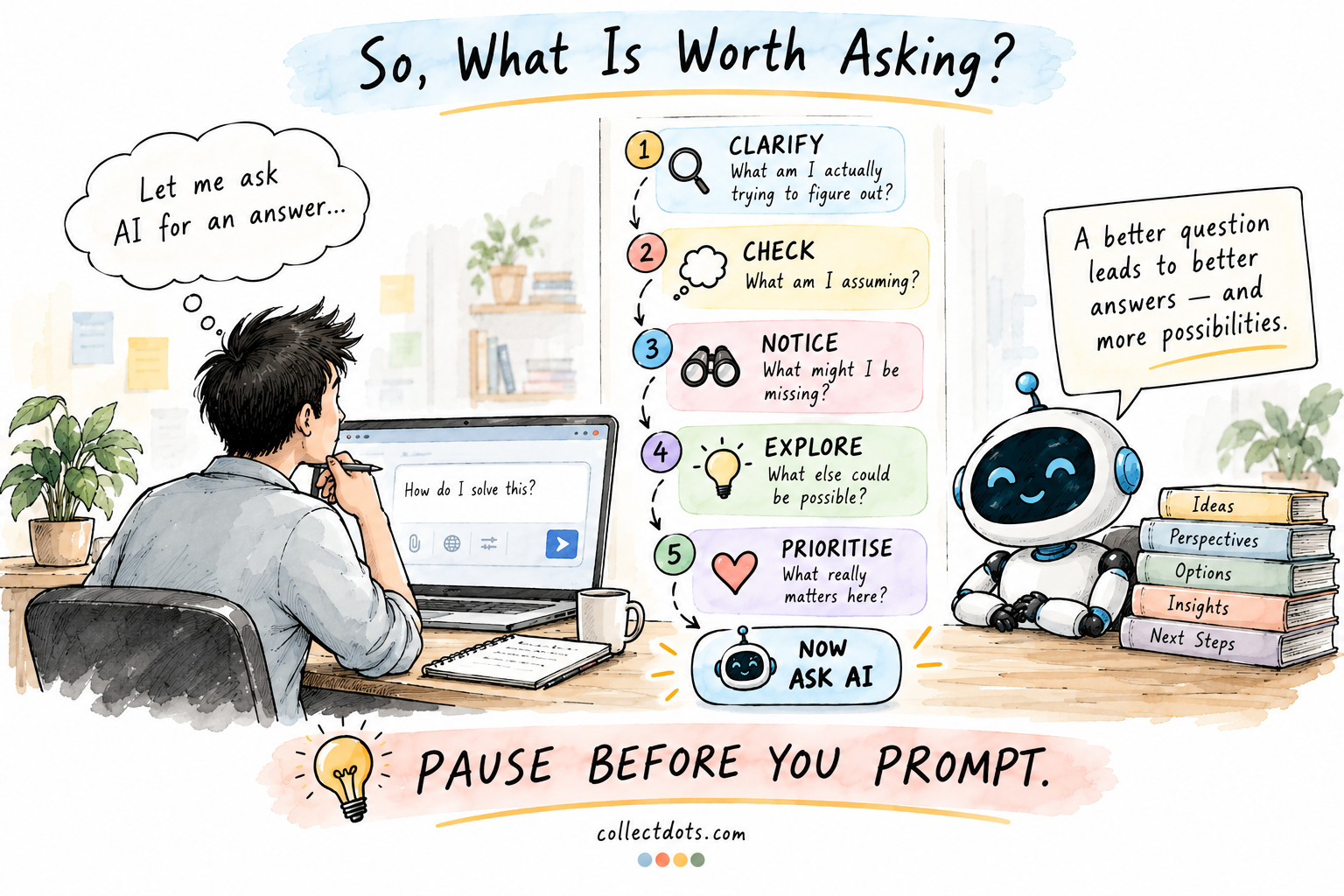
Maybe the biggest lesson I took from The Book of Beautiful Questions is not to replace answers with questions.
It is to pause before asking for the answer.
The next time you are about to ask AI:
“What should I do?”
try asking yourself five small questions first:
1. What am I actually trying to figure out?
2. What am I assuming?
3. What might I be missing?
4. What else could be possible?
5. What really matters here?
Then ask AI.
Now AI isn’t just giving you an answer.
You have given it a better problem to work with.
Research note
Research on metacognition suggests that thinking about how we are thinking can improve the way we approach decisions and learning, which is why a brief pause to examine our assumptions can be useful before jumping to an answer.
Read the research: Dunlosky & Metcalfe, Metacognition
“Perhaps the most useful AI prompt isn’t always the one we type into AI. Sometimes it is the question we ask ourselves first.”
When AI can answer so much, what is worth asking?
The abundance of answers may make the quality of our questions more important, not less.


Leave a Reply